
You open the group chat and see it: a wall of texts that started as a harmless opinion about bouquet colors and has turned into a passive-aggressive standoff. One bridesmaid types in all caps. Another responds with only period-heavy sentences. Someone else has gone silent. Your stomach knots. This is supposed to be a joyful season, not a war zone.
I have been the bride caught in that crossfire. I have also been the bridesmaid who felt overlooked and the maid of honor asked to play referee. Over the years I have learned that conflict is not a sign your wedding is doomed. It is a sign that real people with real feelings are involved. The trick is knowing how to spot the real problem, how to stop it before it escalates, and how to step in when it already has.
Here is what actually works. No fluff, no clichés. Just the steps I have used myself and seen work for dozens of other brides.
The Hidden Reasons Your Bridesmaids Are Clashing
Most advice starts with “just talk it out.” That is like telling someone to fix a car engine by saying “make it run.” You have to know what is broken first.
I once had two bridesmaids who could not stand each other over what seemed like a petty disagreement about seating arrangements. I sat down with each of them privately. The real issue had nothing to do with chairs. One woman felt the other had been dismissive of her recent promotion at work. The other had no idea she had come across that way. The seating argument was just the scab they kept picking.
Common root causes I have seen play out again and again:
- Personality clash. The organizer type wants spreadsheets and deadlines. The free spirit wants spontaneity. Neither is wrong, but they will drive each other crazy without a buffer.
- Financial stress. One bridesmaid can afford the designer dress and the luxury bachelorette. Another is budgeting for a down payment. Money talks create tension fast.
- Unspoken jealousy. A bridesmaid might feel your friendship has changed, or that you are closer to someone else now. That hurt comes out as criticism.
- Role confusion. No one knows who is leading. The maid of honor thinks she is in charge, but another bridesmaid assumes she has equal say. Chaos ensues.
- External stress. A bridesmaid who is going through a breakup, a job loss, or a family crisis may have less emotional bandwidth. Her short fuse has nothing to do with you.
When you understand the underlying cause, you can address the actual wound instead of the surface scratch.
When tensions arise, addressing concerns directly and respectfully can help prevent small misunderstandings from turning into larger conflicts. Practicing healthy communication can also make it easier for everyone involved to feel heard without allowing the disagreement to overshadow the wedding.
Clear expectations can prevent many disagreements before they begin. Having a plan for wedding party communication makes it easier for everyone to stay informed, understand expectations, and avoid unnecessary misunderstandings.
Staying organized can also reduce unnecessary tension. When you coordinate your wedding party around clear roles, schedules, and responsibilities, there’s less room for confusion or frustration.
Stress and disorganization can sometimes contribute to tension within the bridal party. Using the right wedding planning tools can help keep schedules, responsibilities, and important details organized so everyone knows what to expect.
Don’t forget to show your bridal party how much you appreciate their support along the way. Even small gestures or thoughtful bridesmaid gifts can be a meaningful way to thank the friends who are helping you celebrate such an important moment.
How to Set Your Bridal Party Up for Peace Before a Single Fracture Appears
I learned this lesson the hard way. For my own wedding, I assumed everyone would just “get along.” I did not set any expectations. I did not define roles. I let the group chat run wild. Within a month we had a full-blown dress dispute that could have been avoided with one simple email.
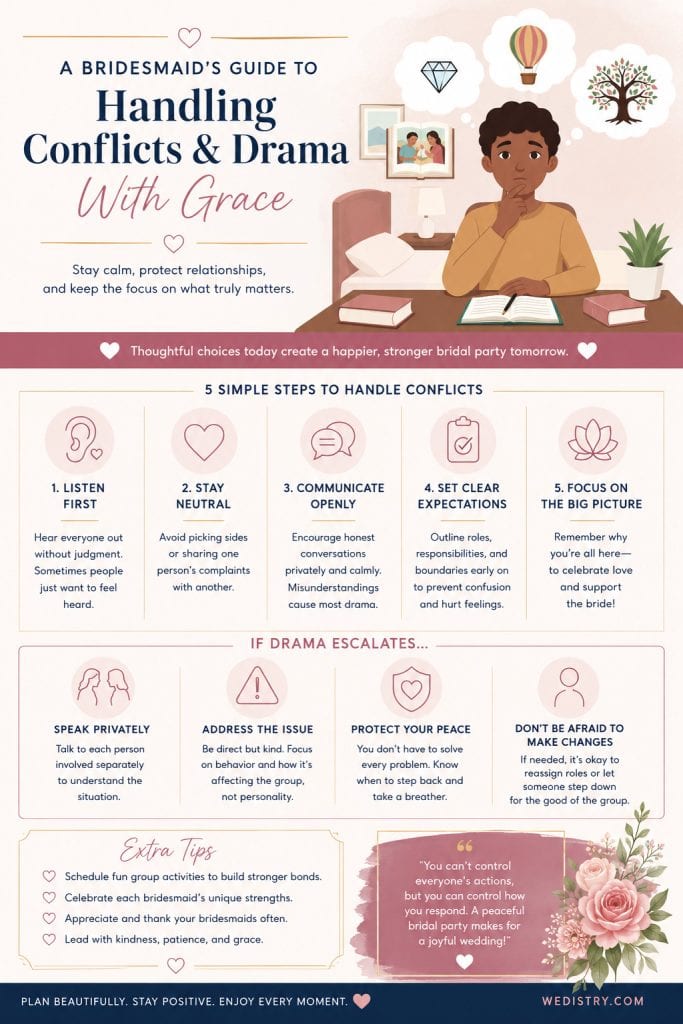
Now I help brides create what I call a squad agreement. It is a short document you share early, before anyone has had a chance to feel wronged. Here is what it includes:
- Clear roles. The maid of honor handles logistics with me. The other bridesmaids bring ideas and energy. No one is the boss of anyone else.
- Communication norms. Group chat is for happy things — outfit photos, funny memes, countdown excitement. Any issue that is not a quick yes/no gets taken to a private message or a phone call. No passive-aggressive posts.
- Budget upfront. I list the estimated costs for dress, alterations, bachelorette, travel, and gifts. Everyone knows the number before they say yes.
- A “no drama” promise. I ask each person to agree that if they feel frustrated, they will come to me directly rather than vent to another bridesmaid. This stops triangulation before it starts.
I also schedule a low-pressure get-to-know-you event early. Not a full bridal shower. Just coffee or a casual brunch where no one talks about wedding tasks. People who have met as humans are much less likely to turn into adversaries later.
The Step-by-Step Protocol When Conflict Explodes
Let me be straight with you: prevention does not always work. Sometimes drama erupts anyway. When that happens, here is the order of operations I have used successfully every time.
Step 1: Pause the group chat immediately.
The chat is a pressure cooker. Hot words get typed, regret follows, and screenshots get shared. I send a simple message: “Let’s take a breather. I am going to switch us to individual texts for a couple of days while I sort something out. Love you all.” Then I mute the chat for everyone temporarily. You can do this by asking everyone in a private message to hold off on posting. If someone continues, you can temporarily disable notifications or even archive the group.
Step 2: Listen to each person privately.
I set up a phone call or a face-to-face coffee with each bridesmaid involved. I start with: “I want to understand how you are feeling. Tell me your side, no interruptions.” I take notes. I do not defend anyone else. I do not share what another person said. This is not a court case. It is data collection.
Step 3: Identify the real issue.
After I have heard everyone, I look for the common thread. Is it the dress color or the feeling of being ignored? Is it the bachelorette budget or the fact that no one asked for her input? The surface complaint is almost never the root. I ask myself: what would fix this for the wedding, not for each person’s ego?
Step 4: Propose a solution that serves the wedding first.
I bring each person back together (still privately or in a small group if they can handle it) and state the solution clearly. For example: “I understand you dislike the burgundy dress. The burgundy stays because it matches the theme. But you can choose a different silhouette that flatters your body. Is that a fair middle ground?” I do not negotiate endlessly. I keep the priority on the wedding day itself.
Step 5: Enforce consequences if needed.
If someone refuses to accept a reasonable solution and continues to disrupt the group, I have a tough conversation. I say: “I love you, but I need you to either get on board or step back from being a bridesmaid. I want you to celebrate with me, but not at the cost of everyone else’s peace.” I have had to do this exactly once. The bridesmaid chose to stay and the drama stopped.
Handling the Three Most Common Bridesmaid Dramas
Some conflicts are so predictable they feel like a script. Here is how to handle the big three.
Drama over the dress
This is the number one source of bridesmaid conflict I have seen. Body image sensitivity plays a huge role. A woman who had a baby six months ago may feel devastated about fitting into a sample size. Another may feel the color washes her out.
My hack: give each bridesmaid a choice of two or three silhouettes in the same fabric and color. That small flexibility removes the pressure. I also send a private note to anyone who seems unsure: “I want you to feel beautiful. Let me know if you need to talk about options.” Do not make dress decisions in the group chat. Those conversations belong one-on-one.
Drama over responsibilities
One bridesmaid is doing everything. Another has done nothing. Resentment builds.
I fix this by creating a shared task list at the beginning. Each person volunteers for specific duties — planning the bridal shower, handling the guest book, coordinating the day-of timeline. When someone slacks off, I do not let the resentment fester. I have a private check-in: “I noticed you have been busy. Can I shift your tasks to someone else so you do not feel overwhelmed?” That either nudges them to step up or frees the overworking bridesmaid without blame.
Drama over the bachelorette party
Money is the hidden land mine. One bridesmaid suggests a weekend rental that costs $500 per person. Another panics but does not speak up.
I ask the maid of honor to send an anonymous budget survey before any planning begins. Everyone checks a box: “I can spend up to $X.” No one’s name is attached. The group then plans within the lowest common denominator. That simple trick has prevented countless arguments.
What Most Advice Leaves Out — The Bride’s Own Role in the Drama
This part is hard to read. I know, because I have been the bride who created drama without realizing it.
Here are the mistakes I see brides make, and have made myself:
- Favoritism. You vent to your best friend about another bridesmaid. That best friend then treats the other bridesmaid coldly. You just started a war.
- Last-minute changes. You switch the dress color six months in. You move the wedding date. You add a new tradition. Each change lands on bridesmaids who have already made plans and purchases.
- Unclear expectations. You expected them to throw you a shower. They thought it was optional. Now everyone is offended.
- Silence. When you see tension, you hope it will fix itself. It will not. Your silence makes it worse.
Self-audit checklist: ask yourself honestly. Have I shown favoritism? Have I changed plans without warning? Have I communicated my expectations? If the answer is yes, apologize. A simple “I realized I put you in a hard spot, and I am sorry” goes miles. Then fix the behavior.
Advanced Option: When to Bring in a Mediator
Some conflicts are too big for you to solve alone. Maybe the conflict involves you directly. Maybe the two bridesmaids refuse to speak. Maybe the emotions are raw enough that anything you say will be seen as biased.
In those cases, bring in a neutral person. The maid of honor can mediate if she is not part of the conflict. If she is, ask a different trusted friend, the wedding planner, or even a professional mediator. I have seen wedding planners resolve budget disputes in ten minutes just by being the calm voice of reason.
Signs it is time to escalate:
- The conflict has lasted more than a week without progress.
- One bridesmaid has threatened to drop out.
- The bride is crying every time she opens her phone.
- Other bridesmaids are taking sides.
When you bring in a mediator, set the ground rules. Everyone speaks in turn. No interrupting. The goal is a workable solution, not a winner.
Frequently Asked Questions
What should I do if a bridesmaid wants to quit?
Let her leave without guilt. Say: “I am sad, but I understand. Your well-being matters more than a role.” Do not try to convince her to stay. A resentful bridesmaid is worse than no bridesmaid. Depending on timing, ask if she would still attend as a guest. Then fill her spot only if you have a close friend who would feel honored, not like a replacement.
How do I handle a bridesmaid who talks badly about another bridesmaid behind her back?
Address it directly and privately. Say: “I heard you said something about Sarah that upset her. I need you to keep concerns between us, not spread them to others. If you have an issue, come to me.” Do not repeat what she said to the other bridesmaid. That feeds the fire. Just stop the behavior.
Can I uninvite a bridesmaid? If so, how?
Yes, but only as a last resort. If a bridesmaid is consistently toxic, disrespectful, or actively harming your wedding experience, you can step her down. Have a conversation in person or on the phone: “I value our friendship, but the dynamic with the group is not working. I need you to step back from being a bridesmaid. I still want you to celebrate with me as a guest.” Expect her to be hurt. That is okay. Your peace matters.
What if my fiancé or partner tries to get involved in bridesmaid drama?
Politely ask them to stay out. Your bridal party dynamic may also include honorary bridesmaids, whose role and expectations differ from those of traditional bridesmaids.. If your partner offers input, thank them and say you will handle it. Their involvement can make things more complicated, especially if they take sides. Keep the boundary firm.
How do I apologize to a bridesmaid I have been accidentally ignoring?
Be specific. Do not say “I am sorry if I hurt you.” Say “I noticed I have been focused on the planning and I have not checked in with you. That was not fair. I value your time and want to hear how you are doing.” Then follow up with a genuine check-in, not a wedding-related ask.